

Head Coverings in Early Christianity
Early Christian writings generally teach that women should cover their heads when praying or worshiping, while men should not cover theirs. Tertullian says this very directly, and Clement of Alexandria and the Apostolic Constitutions say the same in different ways. The main Bible text behind the discussion is 1 Corinthians 11. This page gathers the clearest early witnesses on that teaching.
108 early-church witnesses · 198 source quotations · compared with Scripture
What did early Christians believe about head coverings?
Early Christian teaching said women should cover their heads in prayer and worship, and men should not cover theirs. Tertullian says plainly that “every woman” should be veiled, while Clement of Alexandria and the Apostolic Constitutions also speak of women praying with covered heads. The Bible passages most directly tied to the issue are 1 Corinthians 11:3-7 and 11:13, which early writers repeatedly use as the main basis for the practice.
The evidence is broad among third-century Latin and Greek writers, though it is strongest for women in prayer and worship, not for every public setting in every later church custom. Many more early Christian quotations, Bible passages, and source links are gathered below so you can study the evidence for yourself.
Key Takeaways
- Early Christians most often applied head covering to women in prayer and worship.
- Tertullian is one of the clearest early voices, and Clement of Alexandria agrees.
- 1 Corinthians 11 is the main Bible passage early writers used.
- The evidence is strongest for worship settings, not for every moment of daily life.
Questions Answered by the Sources
Did early Christians teach that women should pray with their heads covered?
The clearest witnesses say women should not pray with an uncovered head. Tertullian explicitly applies 1 Corinthians 11:5 to women of every age and condition, and the Apostolic Constitutions also say women should approach with their heads covered.
-
Tertullian, On the Veiling of Virgins Direct teaching
...lso deserve who, during the reciting of the Psalms, and at any mention of the name of God, continue uncovered; who even when they are about to spend time in prayer itself, with the utmost readiness place a fringe, or a tuft, or any thread whatever, on the crown of their heads, and suppose themselves to be covered? They falsely imagine their head to be of so small extent. Others, who think the palm of the hand plainly greater than any fringe or thread, misuse their head no less. They are like a certain creature, more beast than bird, although winged, with a small head, long legs, and also an upright walk. They say that when she has to hide, she pushes her head alone into a thicket—plainly the whole of it—leaving all the rest of herself exposed. Thus, while she is secure in head, but bare in her larger parts, she is taken wholly, head and all. Such will be their plight as well, covered as they are less than is useful.
-
Tertullian, On Prayer Direct teaching
... within that sex, the virgin also is included. But the statement is plain: "Every woman," he says, "praying and prophesying with head uncovered, dishonors her own head." 1 Corinthians 11:5 What is every woman but woman of every age, every rank, and every condition? By saying every, he excludes nothing of womanhood, just as he excludes nothing of manhood either from not being covered. For in just the same way he says, "Every man." 1 Corinthians 11:4 As then, in the male sex, under the name of man, even the youth is forbidden to be veiled, so too in the female sex, under the name of woman, even the virgin is commanded to be veiled. In each sex alike, let the younger age follow the discipline of the elder. Or else let the male virgins also be veiled, if the female virgins are not veiled because they are not mentioned by name. Let man and youth be different, if woman and virgin are different. For indeed, it is "on account of the angels," 1 Corinthians 11:10 that he says women must be veiled, because on account of the daughters of men angels revolted from God. Who then would argue that women alone, that is, those already married and no longer virgins, were the objects of angelic desi
-
Apostolic Constitutions, Apostolic Constitutions Direct teaching
Let the women approach with their heads covered, as is becoming the order of women;
-
Tertullian, On Prayer Direct teaching
But, withal, the declaration is plain: Every woman, says he, praying and prophesying with head uncovered, dishonours her own head.
-
Clement of Alexandria, The Stromata (Miscellanies) Supporting witness
The ruling power, therefore, is the head. And if the Lord is head of the man, and the man is head of the woman, then the man, being the image and glory of God, is lord of the woman. Therefore it is also written in the Epistle to the Ephesians, “Submitting yourselves to one another in the fear of God. Wives, submit yourselves to your own husbands, as to the Lord. For the husband is head of the wife, just as Christ is the head of the Church; and He is the Savior of the body. Husbands, love your wives, just as Christ also loved the Church. So men also ought to love their wives as their own bodies. He who loves his wife loves himself. For no man has ever yet hated his own flesh.” Ephesians 5:21-29. And in the Epistle to the Colossians it is said, “Wives, submit yourselves to your own husbands, as is fitting in the Lord. Husbands, love your wives, and do not be bitter against them. Children, obey your parents in all things, for this is pleasing to the Lord. Fathers, do not provoke your children to anger, lest they become discouraged. Servants, obey in all things those who are your masters according to the flesh. Do not serve only when watched, like people-pleasers, but with sincerity of
-
Clement of Alexandria, The Instructor (Paedagogus) Supporting witness
...ion should be similar. For just as it is common to both to need things to cover them, so also their coverings should be similar, although such a covering ought to be used as is required for covering the eyes of women. For if the female sex, because of weakness, desires more, we ought to blame the habit of that evil training, by which men brought up in bad habits often become more effeminate than women. But this must not be yielded to. And if some accommodation is to be made, they may be permitted to use softer clothes, provided they put away fabrics that are foolishly thin and finely woven, and bid farewell to embroidery of gold and Indian silks and elaborate Bombyces, or silks. At first it is a worm. Then from it comes a hairy caterpillar. After that, the creature undergoes a new transformation into a third form, which they call larva. From this a long filament is produced, like the spider's thread from the spider. For these superfluous and transparent materials are proof of a weak mind, since they cover the shame of the body with only a thin veil. For luxurious clothing that cannot hide the shape of the body is no longer a covering. Such clothing falls close to the body and ta
-
Apostolic Constitutions, Apostolic Constitutions Supporting witness
...efore we do not advise it, for it is dangerous, or rather wicked and impious. For if the man is the head of the woman, and he was originally appointed to the priesthood, it is not right to set aside the order of creation and leave the chief part to go to the last part of the body. For the woman is the body of the man, taken from his side and subject to him, from whom she was separated for the bearing of children. For He says, “He shall rule over you,” Genesis 3:16. For the chief part of the woman is the man, since he is her head. But if in the earlier constitutions we have not permitted them to teach, how will anyone allow them, against nature, to carry out the office of a priest? For this is one of the ignorant practices of Gentile atheism: to appoint women priests for the female deities. It is not one of the constitutions of Christ. For if baptism were to be administered by women, then certainly our Lord would have been baptized by His own mother, and not by John. Or when He sent us to baptize, He would have sent women along with us for this purpose also. But as it is, He has nowhere, either by constitution or by writing, handed down to us anything like this, because He knew t
-
Tertullian, De Corona Background
Among the Jews, so usual is it for their women to have the head veiled, that they may thereby be recognised.
-
Apostolic Constitutions, Apostolic Constitutions Direct teaching
Look downward when you walk abroad, veiling yourself as becomes women.
-
Clement of Alexandria, The Instructor (Paedagogus) Direct teaching
For this is the wish of the Word, since it is becoming for her to pray veiled.
-
1 Corinthians 11:6 Direct teaching
For if a wife will not cover her head, then she should cut her hair short. But since it is disgraceful for a wife to cut off her hair or shave her head, let her cover her head.
-
1 Corinthians 11:5 Direct teaching
But every woman that prayeth or prophesieth with her head uncovered dishonoureth her head: for that is even all one as if she were shaven.
More related quotations from this section 4 shown
-
1 Corinthians 11:13 Direct teaching
Judge among yourselves. Is it proper for a woman to pray to God with her head uncovered?
-
1 Corinthians 11:3 Supporting witness
But I would have you know, that the head of every man is Christ; and the head of the woman is the man; and the head of Christ is God.
-
1 Corinthians 11:10 Supporting witness
For this reason the woman ought to have a symbol of authority on her head, because of the angels.
-
Leviticus 13:45 Background
And the leper in whom the plague is, let his garments be ungirded, and his head uncovered; and let him have a covering put upon his mouth, and he shall be called unclean.
Did early Christians say men should not cover their heads in prayer?
The Bible passage used by the early writers says a man praying with a covered head dishonors his head. Clement, Methodius, and Tertullian all appeal to that rule when discussing Christian practice.
-
Methodius, Connection to 1 Corinthians 11:7 Direct teaching
as being the form which the Deity Himself employs, as the most wise Paul explains: "For a man indeed ought not to cover his head, forasmuch as he is the image and glory of God; "
-
1 Corinthians 11:4 Supporting witness
Every man praying or prophesying, having his head covered, dishonors his head.
-
1 Corinthians 11:7 Supporting witness
For a man indeed ought not to cover his head, forasmuch as he is the image and glory of God: but the woman is the glory of the man.
Why did early Christians think women should wear a veil?
The sources connect veiling to headship, propriety, and the order of worship. Clement and the Apostolic Constitutions use the language of head and body order, while 1 Corinthians 11 supplies the underlying scriptural framework.
-
Tertullian, On the Veiling of Virgins Supporting witness
(It is this.) If an uncovered head is a recognised mark of virginity, (then) if any virgin falls from the grace of virginity, she remains permanently with head uncovered for fear of discovery, and walks about in a garb which then indeed is another's.
-
Tertullian, On the Veiling of Virgins Supporting witness
... of the law? If a virgin is not a woman, then a stripling is not a man either. If the virgin is not covered on the plea that she is not a woman, then let the stripling be covered on the plea that he is not a man. Let the same virginity share the same indulgence. As virgins are not compelled to be veiled, so let boys not be bidden to be unveiled. Why do we partly acknowledge the apostle's definition as absolute in regard to every man, without entering upon disquisitions as to why he did not also name the boy, but partly evade it, though it is equally absolute in regard to every woman? He says, "If any is contentious, we have not such a custom, nor does the Church of God." He shows that there had been some contention about this point. To put an end to it, he uses the whole compendiousness of language. On the one hand, he does not name the virgin, in order to show that there is to be no doubt about her veiling. On the other hand, he names every woman, whereas he would have named the virgin if the question had been confined to her. So too the Corinthians themselves understood him. In fact, even to this day the Corinthians veil their virgins. What the apostles taught, their disciples
Common Questions
Did early Christians think women should wear head coverings?
Yes. Writers like Tertullian, Clement of Alexandria, and the Apostolic Constitutions say women should pray with covered heads.
What Bible passage did early Christians use for head coverings?
They most often used 1 Corinthians 11:3-7 and 11:13.
Did early Christians also expect men to cover their heads?
No. 1 Corinthians 11:4 and writers like Tertullian and Methodius say men should not cover their heads in prayer.
Source Index for Head coverings
The guided sections above show the strongest quotations. This compact index highlights 160 ranked source links from 198 compiled sources for deeper study.
Source index 160 ranked links shown
Early Christian Writings 80 shown of 108
Primary-source quotations from early Christian writers and church documents.
-
Unknown, Unknown Work
-
Unknown, Unknown Work
-
Unknown, Unknown Work
Bible Passages 80 shown of 90
Related Bible passages saved for comparison with the early Christian quotations.
-
Book 79 1:34
-
Book 79 1:32
Related Resources
 Resource
What does 1 Corinthians 11:2-16 mean?
Verse-by-verse: what the early church taught on the whole passage.
Resource
What does 1 Corinthians 11:2-16 mean?
Verse-by-verse: what the early church taught on the whole passage.
 Video
14 Objections to the Head Covering Answered — Daniel Willis (sermon)
Every common objection to 1 Corinthians 11, answered from Scripture and history.
Video
14 Objections to the Head Covering Answered — Daniel Willis (sermon)
Every common objection to 1 Corinthians 11, answered from Scripture and history.
 Video
The Headcovering: The Beauty of a Woman — Jason Willis (sermon)
The beauty and meaning of the covering in Christian life.
Video
The Headcovering: The Beauty of a Woman — Jason Willis (sermon)
The beauty and meaning of the covering in Christian life.
 Video
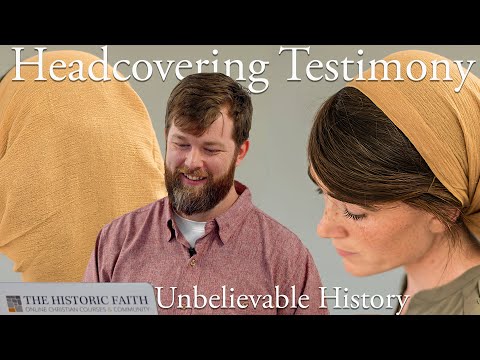
Head Covering Testimony & History — Daniel Willis (sermon)
The history of the head covering — not what you think.
Video
Head Covering Testimony & History — Daniel Willis (sermon)
The history of the head covering — not what you think.
 Course Lesson
Headship and Head-Covering: Interpreting 1 Corinthians 11 (free course)
The complete free video course on 1 Corinthians 11.
Course Lesson
Cultural or Counter-cultural? — Headship & Head-Covering course lesson
Was 1 Corinthians 11 only for that culture? The lesson that answers it.
Course Lesson
Answering Common Objections to Head Coverings
Open a related course lesson for more teaching connected with Head coverings.
Course Lesson
Headship and Head-Covering: Interpreting 1 Corinthians 11 (free course)
The complete free video course on 1 Corinthians 11.
Course Lesson
Cultural or Counter-cultural? — Headship & Head-Covering course lesson
Was 1 Corinthians 11 only for that culture? The lesson that answers it.
Course Lesson
Answering Common Objections to Head Coverings
Open a related course lesson for more teaching connected with Head coverings.
 Course Lesson
Head Covering
Open a related course lesson for more teaching connected with Head coverings.
Course Lesson
Head Covering
Open a related course lesson for more teaching connected with Head coverings.