
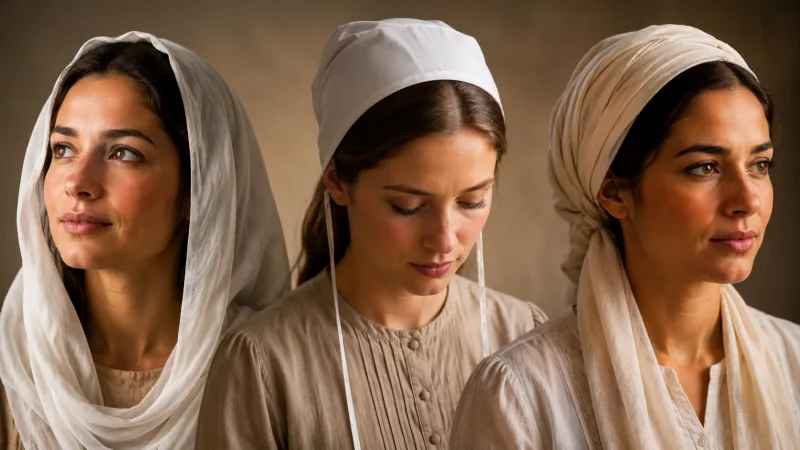
Study Paul's teaching on headship and head covering in 1 Corinthians 11 with Daniel & Jason Willis. This course walks through Scripture, church history, common objections, and practical questions about modesty, authority, prayer, and Christian witness today.

This course is free to access. The Historic Faith is donation-funded, with no paywall and no subscription required. Generous supporters help keep these lessons open to anyone in the world.
Free Course Guide

What This Free Course Covers

This free course examines Paul's teaching on headship and head covering in 1 Corinthians 11 with Daniel & Jason Willis. The lessons begin with a personal and congregational journey into the Christian head covering, then move into the main interpretive questions: whether Paul is speaking about long hair or a fabric covering, whether the practice was only Corinthian culture, and how creation, authority, men and women, prayer, and prophecy shape the passage.

The course also looks at historical Christian practice and early Christian interpretation while answering modern objections. Students should expect a careful, practical study that asks how Scripture, church history, modesty, submission, and Christian witness come together in this debated passage.

1 Corinthians 11 Headship Head covering Apostolic tradition Creation order Christian modesty Men and women Authority and submission Praying and prophesying Church history Christian witness

What You Will Study

  • A personal and congregational journey into studying the Christian head covering
  • A close reading of 1 Corinthians 11 on headship, creation, men and women, and church order
  • Historical evidence for head covering as a Christian practice across time
  • Common objections, including arguments about long hair, Corinthian culture, prostitution, and local custom
  • Why the course argues Paul is referring to a fabric covering and not only to hair
  • How praying and prophesying affect the application of the passage
  • How modesty, beauty, submission, authority, and Christian witness relate to head covering
  • Additional readings and a course survey for students who want to continue reflecting on the topic

Questions This Course Helps Answer

  • Why does 1 Corinthians 11 discuss headship and head covering?
  • Is Paul referring to long hair, a fabric covering, or both?
  • Was head covering only a first-century Corinthian cultural custom?
  • How does Paul’s appeal to creation affect the interpretation of the passage?
  • What does headship mean in relation to men and women?
  • Why does the course call the head covering counter-cultural?
  • How should Christians understand apostolic traditions in 1 Corinthians 11?
  • When and where does the course apply the covering?
  • What role do praying and prophesying play in the passage?
  • How does the course connect head covering with modesty and Christian witness?
  • How does early Christian interpretation help frame the debate?
  • What further readings can help students keep studying headship and head covering?

Lesson-by-Lesson Guide

Our Journey Into the Christian Head Covering

This opening lesson traces a family and church journey into studying 1 Corinthians 11 and the historic practice of head covering. It introduces the course’s concern for Scripture, church history, discipleship, and God’s order for men and women.

  • How did Daniel & Jason Willis begin studying the Christian head covering?
  • Why was the historical practice of head covering surprising?
  • How does the course connect head covering with headship and Christian discipleship?
Answering Common Objections to Head Coverings

This lesson groups and answers common objections to head covering. It addresses arguments about long hair, local culture, prostitution, Corinthian customs, and whether Paul’s instructions should still be received as apostolic teaching.

  • What are the most common objections to the Christian head covering?
  • Is Paul speaking only about long hair?
  • How does the lesson respond to cultural explanations of the passage?
  • Why does early Christian interpretation matter for this debate?

The Head Covering Controversy In Modern Christianity

This lesson explains why head covering feels controversial in modern Christianity. It connects the topic to beauty, modesty, creation, headship, authority, and submission while asking whether modern assumptions have made Paul’s teaching harder to hear.

  • Why does head covering seem strange or unnecessary to many modern Christians?
  • How does the lesson connect beauty with modesty and responsibility?
  • What does the lesson say about authority and submission?
  • How does creation shape the course’s view of men and women?

Cultural or Counter-cultural?

This lesson asks whether Paul’s teaching was merely cultural or actually counter-cultural. It argues that Paul appeals to delivered apostolic tradition and biblical headship rather than simply mirroring Corinthian custom.

  • Was head covering only part of Corinthian culture?
  • What does Paul mean by traditions delivered to the church?
  • Why does the lesson describe head covering as counter-cultural?
  • How does the lesson connect male and female difference with Christian witness?

Long Hair or a Fabric Covering? Just in Church or for Everyday Life?

This lesson focuses on whether 1 Corinthians 11 refers to long hair or a fabric covering. It considers wording, biblical examples, ancient literature, and the question of when the covering applies, especially in relation to praying and prophesying.

  • Does 1 Corinthians 11 refer to long hair or a cloth covering?
  • What arguments does the lesson give for a fabric covering?
  • How do biblical and ancient examples help frame the question?
  • How do praying and prophesying affect the application of the passage?

The Headcovering for Modesty, Liberation, and a Gateway to the Spirit’s Power

This concluding lesson draws together the course’s argument and emphasizes modesty, liberation from worldly pressure, and Spirit-empowered prayer and prophecy. It presents head covering as faithful obedience rather than shame.

  • Why does the lesson connect head covering with modesty?
  • How does the course interpret authority or power on the head?
  • In what sense is head covering described as liberating?
  • How are obedience, prayer, prophecy, and the Spirit’s power connected?

Additional Readings: Headship and Head-covering

This resource page points students to further reading on headship, head covering, and early Christian interpretation so they can continue studying after the main lessons.

  • What additional readings are provided for further study?
  • How do the readings relate to headship and head covering?

Survey: Headship and Head-covering

This final course item invites students to reflect on the course, submit feedback, and complete the course review process.

  • What feedback does the survey request from students?
  • How does the survey help complete the learning path?

What students are saying

4.70 out of 5 — 66 reviews
Amy Zeiset Aug 26, 2026
★★★★☆
very good course!
Erika Martinsson Jul 7, 2026
★★★★☆
Very good course! The only thing missing, is a clarification on why this is not exclusive to married women, but also applies to singles. And along those lines the next question would be at what age and in what context girls should start covering their heads.
Charles Hood Mar 6, 2026
★★★★★
I really appreciated the insights from these lessons. The topics of proper headship, proper submission, and godly modesty are extremely important topics for kingdom-seeking Christians and kingdom-seeking congregations to learn about and practice. May God strengthen our kingdom testimony.
Micah Miller Feb 13, 2026
★★★★★
This is a very thorough course that my wife and I really enjoyed taking together. I love how Kuruvilla unpacks each of the arguments Paul makes, and dismantles all the arguments against the headcovering.
Verified Student Dec 8, 2025
★★★★☆
It seems some of the quiz answers may be wrong... ? In quiz 1 there were a few I wondered about and in quiz 2 numbers 5 & 7.
Help spread the message. Every honest review helps more people discover this teaching through Google and word of mouth. If this course has helped you, sharing a few sentences is one of the simplest ways to support the mission — it’s free, takes about a minute, and reaches people we may never meet.
Headship and Head-Covering: Interpreting 1 Corinthians 11 in the 21st Century

Preview this Course

+569 enrolled
Start Course

Open Registration

Course Includes

  • 8 Lessons
  • 6 Quizzes
  • Course Certificate